TIRAGEfree browser game · made in Luxembourg
TIRAGE, a free card album of Luxembourg in pixel art
Luxembourg in cards. One pack a day.
TIRAGE is a Panini-style album of Luxembourg: 600 cards in ten chapters of 60, from Echternach and Vianden Castle to the Gëlle Fra, Josy Barthel and the Treaty of London of 1867. Every day at midnight, Luxembourg time, a pack of five cards opens, the same for everyone. Doubles become ink, which prints the cards you are missing.
Each card carries five real statistics of its encyclopedia article, recorded once and frozen for the whole edition. With them you take on the deck of the day in a Quartett duel, the playground card game of the region. Edition I is Luxembourg; later editions are planned for the Greater Region, with no date set yet. It plays in the browser, on a phone or a computer, in French or English, offline once loaded, with no ads and no account.
Free, no ads, no account, nothing to buy. Phone, tablet or computer; offline once loaded.
How a pack opens
The pack of the day is drawn from a seed made of the date, in Luxembourg time, and the edition: everyone who opens it on the same day finds the same five cards. A date not opened stays available until midnight only. Packs won in a duel or for a completed chapter wait in a small stack and never expire. Opening one takes three beats.
1/3Tear
The sealed pack fills the screen, with its date and « 5 cards · Edition I ». Drag along the tear strip, tap it, or press Space or Enter.
2/3The edges
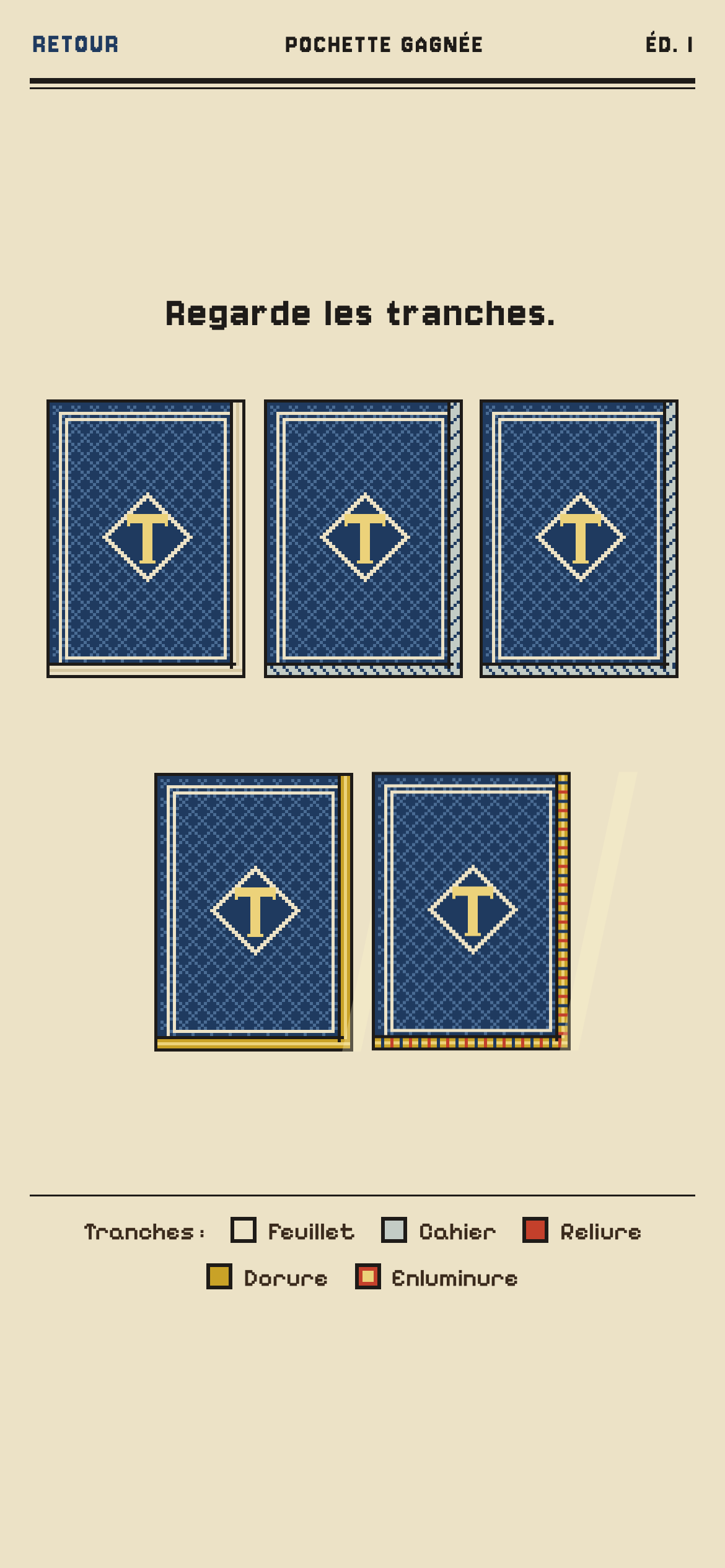
The five cards are dealt face down, three then two on a phone, five in a row on a computer. Each card's edge shows its rank before the flip: plain ecru, blue-grey speckled, red marbled, gilt with a glint, gilt with coloured initials. The game only says « Look at the edges. »
3/3Flip
Tap a card, or press Space, to turn the next one, left to right, the rarest last; « Flip all » turns them all. A Dorure, an Enluminure or a Coquille first trembles on its edge with a short rising note, then turns, with a bell, a choir chord or a misprint jingle.
New cards are stamped « New », doubles show their ink. The summary sets the five cards out as a plate with their captions, then « Paste into the album ».
Five ranks and the Coquille
The ranks come from the book trade and the Echternach scriptorium. Inside each chapter, cards are ranked by fame (the mean of their Readers, Reach and Links notes); each chapter's Enluminure is chosen by hand. Every chapter holds 30 Feuillets, 17 Cahiers, 9 Reliures, 3 Dorures and 1 Enluminure.
- Feuillet
- ecru paper, a single ink rule · edge: plain ecru
- Cahier
- laid paper, blue-grey, stitched corners · edge: blue-grey, speckled
- Reliure
- oxblood leather, raised bands on the left edge · edge: red, marbled
- Dorure
- leather with gilt fillets and gilt corners · edge: gilt, with a glint
- Enluminure
- vellum, Echternach-style knotwork in ink, vermilion, Prussian blue and gold, a red initial · edge: gilt, with coloured initials
- Feuillet
- Cards300
- Per slot62.0%
- At least one per pack99.2%
- One given card1 in 97
- Its Coquille1 in 15,000
- Cahier
- Cards170
- Per slot25.0%
- At least one per pack76.3%
- One given card1 in 140
- Its Coquille1 in 20,000
- Reliure
- Cards90
- Per slot10.0%
- At least one per pack41.0%
- One given card1 in 180
- Its Coquille1 in 27,000
- Dorure
- Cards30
- Per slot2.7%
- At least one per pack12.8%
- One given card1 in 220
- Its Coquille1 in 33,000
- Enluminure
- Cards10
- Per slot0.3%
- At least one per pack1.5%
- One given card1 in 670
- Its Coquille1 in 100,000
The Coquille
The misprint comes from philately. Every drawn card, whatever its rank, has a 1 in 150 chance to come out as a Coquille: the colour plate shifted by one pixel, the picture printed in negative, or the picture and title printed in mirror, the kind fixed for each card number. With five cards, about one pack in 30 holds a Coquille.
A Coquille is kept apart from the normal card in the album: you can own both. It shows on the Roll of honour next to your Enluminures, and a double Coquille gives twice the ink.
The duel and the Renvoi rule
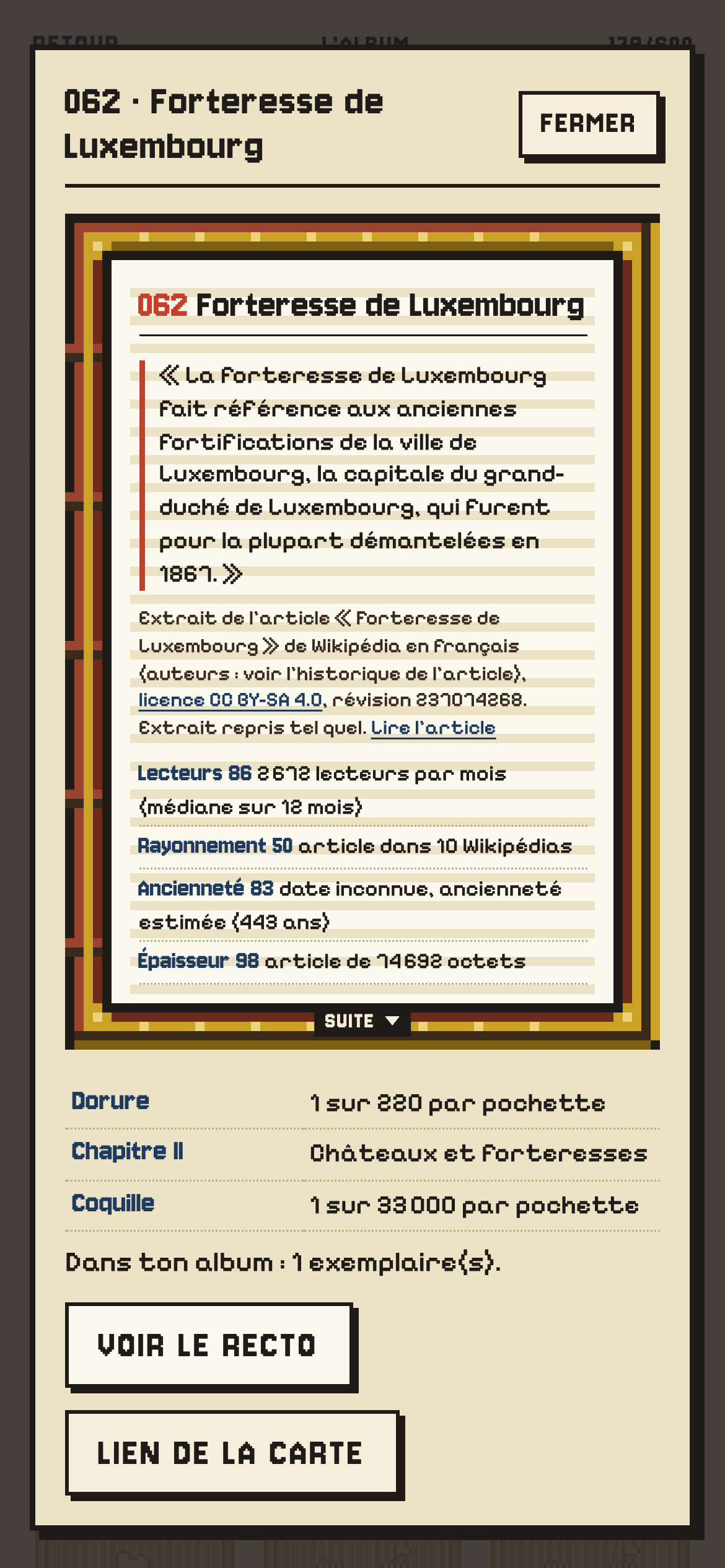
Every card carries five statistics of its article, recorded on 18 October 2026 (21 October for the Luxembourgish and German cards) and frozen for the whole edition. Each raw value becomes a note from 1 to 99, its percentile rank over the 600 cards.
- Readers
- median monthly page views over October 2025 to September 2026, French, English, German and Luxembourgish articles added up.
- Reach
- the number of Wikipedias with an article on the subject.
- Age
- years since the subject's date; a natural subject with no date, such as a river or a forest, takes geological time.
- Depth
- the size of the article in bytes.
- Links
- how many articles link to it.
For the 96 cards sourced in Luxembourgish or German, Depth, Links and Readers are converted into a French equivalent by ratios measured on the subjects that have both articles; the back shows both values.
- Your deck: five distinct cards from your album, picked by hand or with « Best deck ». With fewer than five, loaned cards of the day fill the gaps and never join the album.
- The deck of the day is the same for everyone: five cards from five chapters, three Dorures and two Reliures, each from the stronger half of its rank in its chapter.
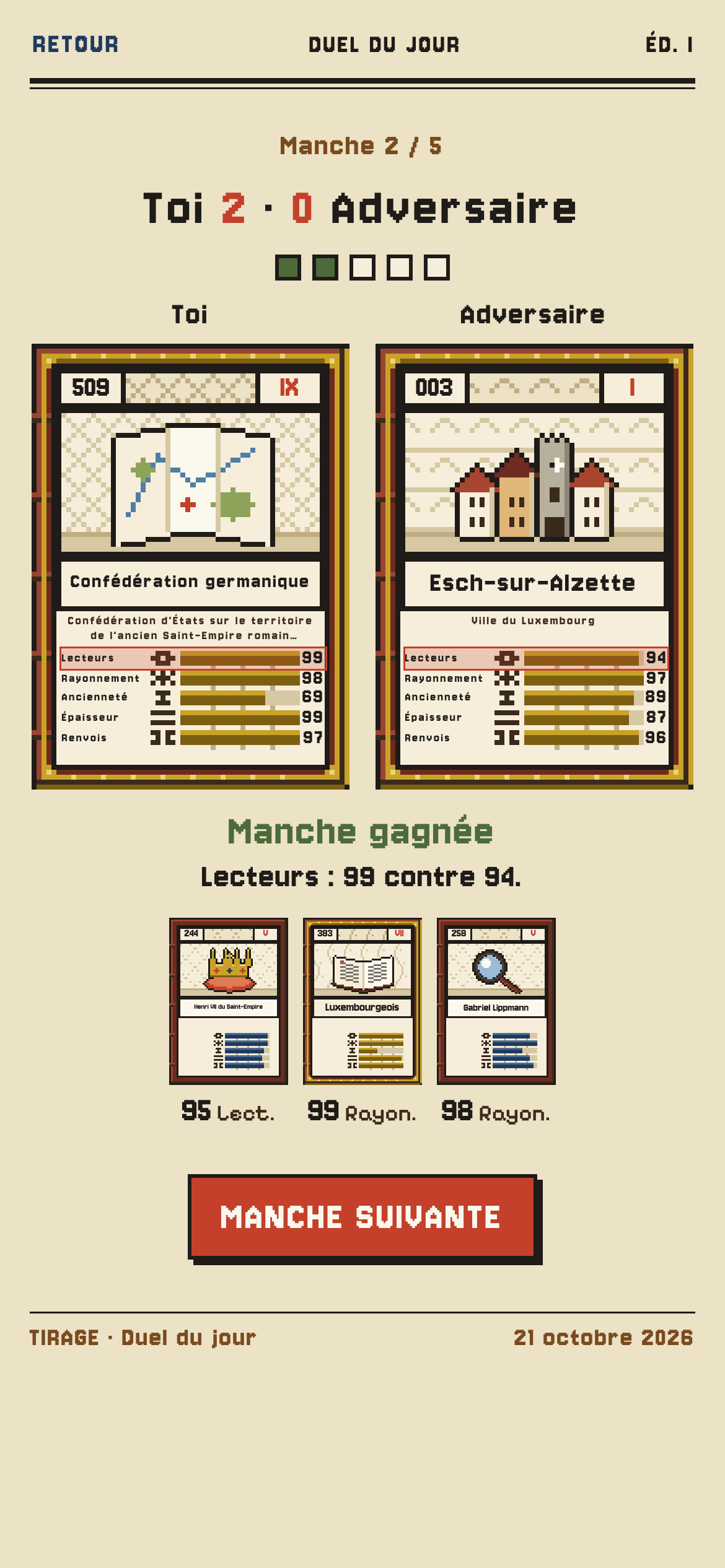
- Five rounds. You lead in round 1, the winner of a round takes the lead, a drawn round keeps it. The opponent's card lies face down, its edge showing its rank.
- With the lead, you pick your card, then the statistic. Without it, the opponent calls its card's best statistic first, and you pick your card.
- The higher note wins; equal notes, the higher raw value; equal raw values, the round is drawn.
- More rounds won than the opponent is a victory. A victory brings a pack, three a day at most; beyond that it is a victory for honour. A defeat costs nothing, and the best result of the day is kept.
Renvoi
If your card's article links to the opponent's article, a link written in its text, and not the other way round, you win the round whatever the statistic. The reverse works for the opponent; when both articles cite each other, the statistic decides. Edition I counts 3,962 such links between its cards, and a Renvoi decides about 8 % of the rounds.
The back of each card lists the cards of the edition its article links to, so you can read your way to a Renvoi.
The album and ink
Ten chapters, slots numbered 001 to 600. An empty slot shows its number and the silhouette of the card's pictogram; tap it to see the card, its back and its odds, even before you own it. Counters run per chapter and overall, and the Roll of honour lists your Enluminures and Coquilles.
Doubles become ink. Ink prints a missing card, once at least half of its chapter is pasted. A completed chapter gives one pack, once. Ink cannot be bought.
- ITowns and villagesEnluminure: Echternach
- IICastles and fortressesEnluminure: Vianden Castle
- IIIRivers, valleys and landscapesEnluminure: Moselle
- IVStations and linesEnluminure: Luxembourg railway station
- VFigures of historyEnluminure: John of Bohemia
- VIEurope and institutionsEnluminure: Schengen Agreement
- VIIFood, feasts and cultureEnluminure: Dancing procession of Echternach
- VIIISport and clubsEnluminure: Josy Barthel
- IXEvents of historyEnluminure: Treaty of London, 1867
- XCuriositiesEnluminure: Gëlle Fra
- Feuillet
- 1
- 20
- Cahier
- 2
- 50
- Reliure
- 5
- 120
- Dorure
- 15
- 300
- Enluminure
- 60
- 1,200
- Curiosities also holds a few subjects that carry Luxembourg's name elsewhere, such as the Jardin du Luxembourg in Paris, stamped « Namesake » on the front.
- Each card has its own link (« Card link »), with its own preview image, that opens it in the game.
Stream mode
One switch in Settings makes the game readable on a broadcast: bigger cards, every beat of the opening 1.6 times slower, and a plain background to key out, paper, green #00b140 or magenta #ff00ff. Three tools come with it.
- The hunt
- Pick a target card in the album. A band shows its number, its title, its exact odds per pack and the packs opened so far, and a fanfare plays when it comes out.
- Free packs
- Endless packs for a marathon, never pasted into the album; a banner says so on every one.
- Chat challenge
- The game makes a code and shows tirage.sitraka.lu/?defi= with it in large type. Everyone who opens that link plays the same five opponent cards, and the chat posts its scores.
Sources and licences
The game never calls Wikipedia or Wikidata. A build script fetched everything once for the edition, one request at a time with an identified User-Agent, and wrote static files that the site serves itself.
- Wikidata
- labels, short descriptions, dates and the list of Wikipedias with an article
- LicenceCC0
- Wikimedia page views
- monthly views of the French, English, German and Luxembourgish articles, October 2025 to September 2026
- LicenceCC0
- Wikipedia (French, English, Luxembourgish, German)
- article sizes and links, which are facts, and the first sentence of each intro, quoted on the back
- LicenceCC BY-SA 4.0
Content drawn from Wikipedia, under the CC BY-SA 4.0 licence. Not affiliated with the Wikimedia Foundation.
This line sits on the title page, the credits page, the privacy page and every card back. The front carries no Wikipedia text. The back quotes the excerpt with the article title, the language, the authors note, the licence with its link, the revision and a « Read the article » link, and says whether the excerpt was quoted as is or shortened.
504 cards are sourced on French Wikipedia; 96 whose best article is in Luxembourgish (74) or German (22) quote that article in its language, with a translation written for TIRAGE above it, labelled as such and published under the same CC BY-SA 4.0 licence. Only people who have died have a card.
TIRAGE has its own look, paper and ink in pixel art: no Wikipedia or Wikimedia logo, no puzzle globe, nothing that imitates the encyclopedia's pages, and no Wikimedia mark on the share images.
Statistics are recorded once per edition. Editing Wikipedia changes nothing on your cards: please leave the encyclopedia alone.
How to play
- 1.Open today's pack. Five cards, the same for everyone. A new one at midnight.
- 2.Paste them into the album. 600 slots in ten chapters. A double becomes ink, which prints a missing card.
- 3.Take on today's deck. Five cards against five, the higher note wins the round. A victory earns a pack.
- Tear the pack
- TouchDrag along the strip, or tap it
- KeyboardSpace or Enter
- Flip a card
- TouchTap it, or « Flip all »
- KeyboardSpace or Enter
- Open a card of the album
- TouchTap it
- KeyboardEnter or Space
- Close a card or a dialog
- Touch« Close »
- KeyboardEsc
- The game speaks French or English, chosen from your browser's language and switchable in Settings, with animations (full or reduced) and sounds.
- Once loaded, the game works offline and can be installed on the home screen.
Privacy
TIRAGE asks for no account, sets no cookie, shows no ads, sells nothing and embeds no third-party tracker. Your album, your ink, your packs, your best duel scores and your settings stay in your browser's localStorage, on this device only. Settings › Export the album and Import an album move it to another device; Settings › Erase my progress erases everything.
Visits are counted by Vercel Web Analytics, without cookies: one page view on opening (the address without its parameters), then at most 8 anonymous markers a day. No card, no name and no score is ever sent. Open the game with ?optout=1 to leave your device out.
« Read the article » opens Wikipedia, the share buttons open X, WhatsApp, LinkedIn, Facebook or Reddit, and « Buy me a coffee » opens buymeacoffee.com, all in a new tab; the game sends nothing to them.
Credits
A game by Sitraka Forler, in Sitraka Labs.
Texts and data: Wikipedia contributors (CC BY-SA 4.0), Wikidata (CC0), Wikimedia page views (CC0); every card's article, revision and Wikidata item is listed on the credits page.
Fonts: Jersey 10 by The Soft Type Project Authors and Pixelify Sans by The Pixelify Sans Project Authors, both under the SIL Open Font License 1.1.
Everything else is made in the code: five frame materials, ten chapter motifs, about sixty pictograms, the pack and the lettering are drawn as pixel art, and the sounds are synthesised in the browser. No photograph and no image from Wikimedia Commons.
Questions
- Is TIRAGE free?
- Yes. No ads, no purchase, no account, no trade. Ink, the game's only resource, cannot be bought.
- Is it made by Wikipedia?
- No. Content drawn from Wikipedia, under the CC BY-SA 4.0 licence. Not affiliated with the Wikimedia Foundation. TIRAGE is a personal project of Sitraka Forler that quotes the encyclopedia and credits it on every card back.
- Is the pack of the day really the same for everyone?
- Yes. It is drawn from a seed made of the date, in Luxembourg time, and the edition, so it turns at midnight in Luxembourg for everyone. The deck of the duel of the day is the same for everyone too.
- What are my chances of an Enluminure?
- Each slot has a 0.3% chance of an Enluminure, so about 1 in 67 packs holds one. A given Enluminure comes out about once in 670 packs. Any drawn card has a 1 in 150 chance to be a Coquille.
- Can I improve a card by editing Wikipedia?
- No. Statistics are recorded once per edition. Editing Wikipedia changes nothing on your cards: please leave the encyclopedia alone.
- Can I play it on a stream?
- Yes. Turn on stream mode in Settings: bigger cards, slower flips, a green or magenta background to key out, the hunt for a target card, free packs that never touch the album, and chat challenges carried by a code in the link.
- Where is my album?
- In your browser, on this device only. There is no account and no sync; Settings › Export the album saves it as a file that Import an album reads on another device. Settings › Erase my progress erases everything.
TIRAGE is a personal project of Sitraka Forler, in Sitraka Labs. Content drawn from Wikipedia, under the CC BY-SA 4.0 licence; not affiliated with the Wikimedia Foundation.